
What Divorce Actually Costs You in Tax
Nobody going through a separation thinks primarily about tax. There is too much else happening. But the financial consequences of how and when you move assets between you and your former spouse can be substantial, and they arrive without warning if you haven't been advised on them. Capital gains tax, stamp duty, pension sharing, and income tax each carry their own rules in the context of divorce, and several of those rules changed significantly in the last three years. Here is what you need to understand.

The Three-Year Window, and Why Timing Is Everything
When you are married and living together, you can transfer assets between you without triggering capital gains tax. The transfer is treated as happening at the original acquisition price, so no gain is recognised and no tax falls due. Once you separate permanently, that protection begins to run out, and the rules that govern how long it lasts are more nuanced than most people realise.
Under reforms that came into effect in April 2023, separating spouses now have up to three full tax years after the year of separation to transfer assets on a "no gain, no loss" basis. So if you separated in, say, August 2025, you and your spouse would have until 5 April 2029 to complete transfers between you without triggering an immediate CGT charge. Before the reforms, the deadline was simply the end of the tax year in which you separated, which often meant a window of only weeks.
The no gain, no loss protection applies indefinitely if transfers form part of a court-approved consent order. This distinction between a formal agreement and an informal one is where people get caught.
The three-year window is the floor, not the ceiling. Transfers made as part of a court-approved consent order or formal divorce agreement are exempt from CGT with no time limit at all. This matters enormously in cases where financial proceedings are complex and take years to resolve. The critical point is that "formal" means court-sanctioned, not just an arrangement both parties have agreed in writing between themselves.
One other change that came in with the 2023 reforms is worth knowing if you are the spouse who moves out of the family home. If you vacate the property and later receive a share of the sale proceeds under a deferred sale arrangement (common when children are living there and a sale is postponed), you will now be able to apply the same Private Residence Relief to your proceeds that would have applied when you originally left the property. Previously, the departing spouse could find themselves liable for CGT on a home they had not lived in for years. That trap has been largely closed.
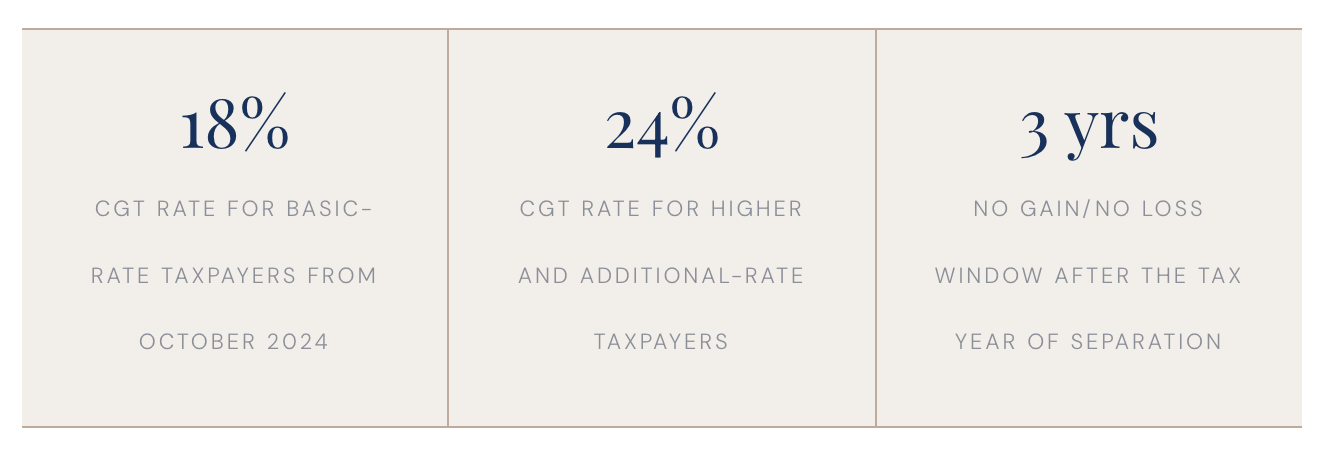
The Autumn Budget 2024 also raised CGT rates. Basic-rate taxpayers now pay 18% on gains, and higher or additional-rate taxpayers pay 24%. These rates apply to most assets. If the CGT window closes on your separation before transfers are completed, you could find yourself paying tax at those rates on the market value of assets that have increased significantly since they were acquired. Getting a consent order in place is not just a legal formality; it is often the single most important piece of tax planning available to you.
A note on the family home specifically. Private Residence Relief generally means no CGT on the sale of a property that has been your main home throughout your ownership. If you move out and the property is sold within nine months, relief should still apply in full. Beyond nine months, some of the gain may become taxable, depending on whether the sale falls under a formal divorce agreement and whether you have nominated another property as your main residence. If you have bought elsewhere, you cannot simultaneously elect both properties.
Stamp Duty Land Tax
Transferring the Family Home: When SDLT Applies and When It Does Not
If one of you is buying out the other's share in the family home, or if the property is being transferred from joint names into sole ownership as part of the settlement, SDLT may or may not apply. The outcome depends almost entirely on how the arrangement is documented.
Transfers made pursuant to a court order or formal separation agreement are exempt from SDLT entirely, regardless of the value of the property or the mortgage being assumed. HMRC does not even need to be notified. Transfers made informally, without a court order in place, are assessed on the chargeable consideration, which means both any cash paid and any share of the mortgage being taken on. If that combined figure exceeds £125,000 (the residential threshold from April 2025), SDLT is due.
This catches more people than you might expect. Two people who agree a fair split between themselves, execute a transfer of equity with a solicitor, and never formalise matters through the court can find themselves with a stamp duty bill they had not anticipated. The solicitor processing the transfer is not responsible for your tax planning. Get the court order first.
The chargeable consideration is not just the cash you pay. It also includes any share of the mortgage you take on. On a property with a large outstanding loan, that figure can be significant even if no money changes hands directly.
Pensions
The Asset Most Women Undervalue in Settlement
Pensions are frequently the largest single asset in a marriage after the family home, and they are consistently undervalued in settlements, particularly by women who have taken time out of the workforce. A pension sharing order transfers a defined portion of one spouse's pension into a separate fund in the other's name. A pension offsetting arrangement leaves the pension with its original owner but compensates the other party with a larger share of another asset, often property.
Neither approach triggers an immediate income tax or CGT charge at the point of transfer. The tax implications come later, when the pension is drawn. For the spouse receiving a pension share, contributions and growth will be taxed as income in the normal way when they access the funds in retirement. The key consideration during settlement is not the tax on transfer but rather the long-term value being exchanged. A property worth £400,000 today has a known value. A pension worth £400,000 in transfer terms may be worth considerably more or less in real terms depending on when and how it is drawn, the tax rate applicable to the recipient at that point, and the type of scheme.
Something else that has changed, and matters in this context, is the treatment of pensions for inheritance tax purposes. From April 2027, most unused pension funds and death benefits will be brought into a person's estate for IHT, potentially subject to 40% tax above the nil-rate band. Until now, pensions have sat outside the estate entirely, which made them powerful vehicles for passing wealth to the next generation. That advantage is being removed. If pension splitting or offsetting forms a significant part of your divorce settlement, this change is relevant to how those assets should be thought about over the longer term, and it is worth discussing with a financial adviser who understands both divorce law and estate planning.
Don’t forget to update your pension nomination forms. After any separation, review and update the expression of wishes on every pension you hold. These forms instruct trustees on who should receive your pension on death, and they operate independently of your will. A nomination that names a former spouse can remain in place indefinitely unless you change it. With pensions moving into the IHT net from 2027, the choice of beneficiary carries even more planning weight than it did before.
Income Tax
How Your Tax Position Changes the Moment You Are Single
Once you are no longer married, you are taxed as a single individual. This is usually straightforward, but there are a few points that catch people out in the first year or two after separation.
If you and your former spouse held income-producing assets jointly, rental income from a jointly held investment property for example, you were previously taxed on your share of that income. Once the asset is transferred as part of settlement, the income tax position depends on who now owns what, and when. If a property transfer completes partway through a tax year, income tax can fall in an unexpected way for that year. If your spouse was previously the higher earner and assets were structured around that, your own tax position may shift considerably.
Maintenance payments are not taxable income for the recipient and not tax-deductible for the payer, with very limited exceptions for older agreements that predate 1988. Child maintenance follows the same rule. Spousal maintenance paid voluntarily is simply income spent; it carries no tax benefit.
If your income changes significantly as a result of divorce, whether because of a change in employment status, receipt of investment income, or a pension share that begins to be drawn, it is worth reviewing your tax code with HMRC and considering whether self-assessment applies to you for the first time.
Why Tax Planning Is Part of the Legal Process, Not Something That Comes After
The taxes that fall on divorce are not inevitable. Most of them are avoidable with the right advice at the right moment. Capital gains tax exposure can be eliminated entirely if transfers happen under a formal court order. Stamp duty disappears in the same circumstance. The timing of separation relative to the tax year, the structure of a consent order, the language of a pension sharing order, the nomination form on a SIPP: each of these details shapes the financial outcome of a settlement in ways that no amount of goodwill between separating parties can fix after the fact.
A good family solicitor will know when to bring in a tax specialist, and a good financial adviser will understand the divorce framework well enough to contribute meaningfully to settlement discussions. The gap between those two disciplines is where the costly surprises live. If you are navigating a separation, ask early and ask specifically whether a tax adviser should be involved in your case.
The taxes that fall on divorce are not inevitable. Most of them are avoidable with the right advice at the right moment.