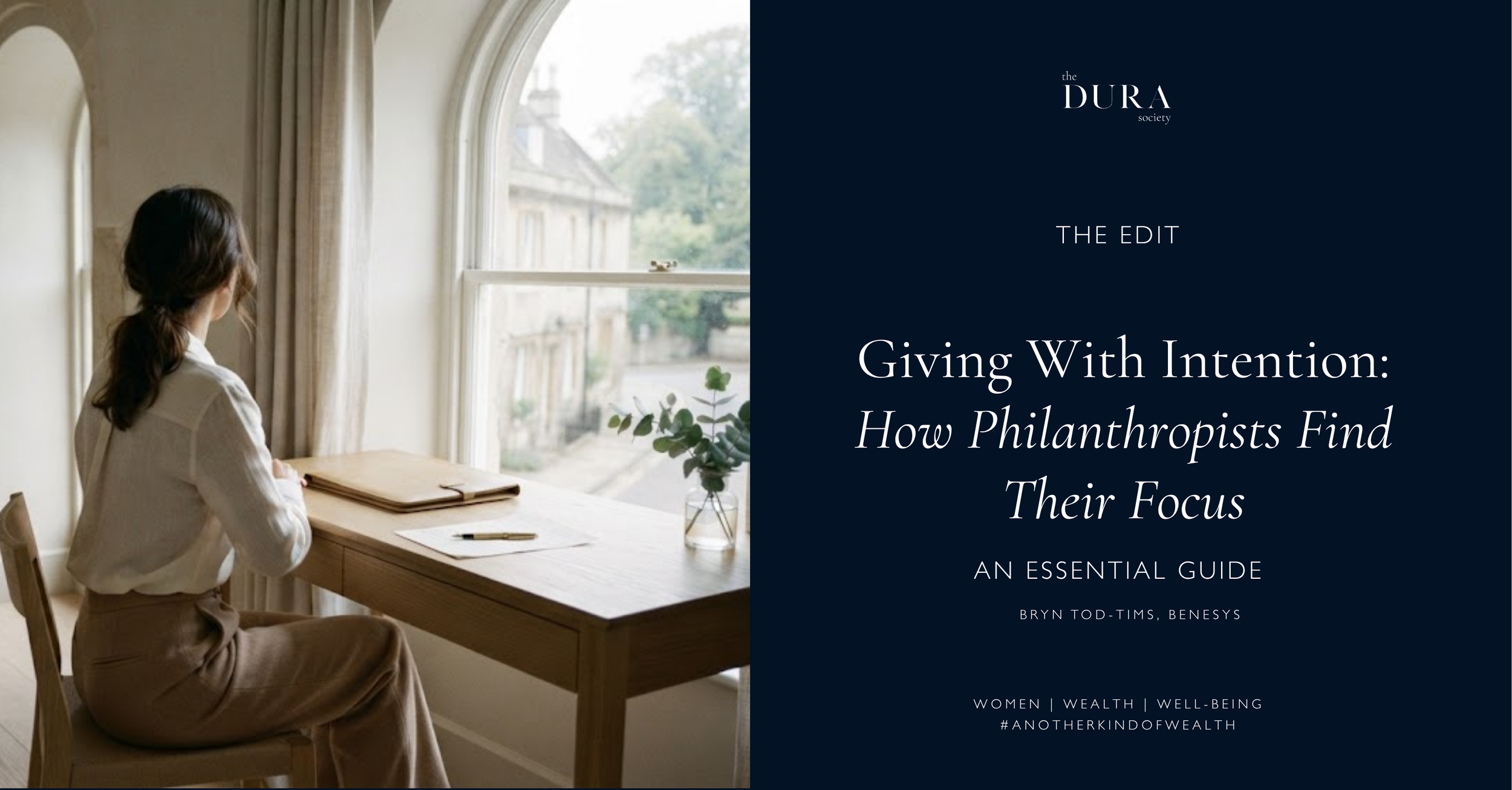
Giving With Intention: How Philanthropists Find Their Focus
Most people could name every fund manager in their portfolio. Few could name a single outcome from their last charitable gift. That gap, between the discipline applied to wealth and the discipline applied to giving it away, was the starting point for our latest Essential Series session with Bryn Tod-Tims, Co-Founder of Benesys.
Benesys was founded in 2018 as an impact advisory and consultancy, built on a simple premise: philanthropy deserves the same rigor as investing. The firm works with individuals, families, businesses and foundations to set up their giving, then manages and reports on it over time, treating impact as something to be pursued with the same discipline as financial return.
That discipline starts with a process Benesys calls discovery, development and delivery. The first stage, a discovery consultation, is not about picking causes. It is about understanding what change a client wants to create in the world, what resources they have to do it, and how they actually want to give. Some clients want to donate money alone. Others want to combine capital with time, board positions or fundraising events. From that first conversation, a mission and a set of goals start to take shape, and this is where the ongoing work of due diligence, risk assessment and impact reporting begins. It is this continuity, Tod-Tims explained, rather than the initial planning, that keeps giving disciplined over years and decades.
Many philanthropists arrive at causes by chance rather than design. A personal connection, an invitation, a friend's introduction. Tod-Tims does not see this as a problem to correct so much as a starting point to refine. Once a client has a clear mission, expressed in what Benesys calls a giving manifesto, it becomes far easier to see which incoming requests genuinely align with their goals and which do not. Clients typically allocate their giving across several categories: key charity partners who have been through rigorous risk assessment and receive ongoing multi-year support, one-off donations to charities that do not fit neatly into the core portfolio, and an allocation for community or network-driven giving, where clients attend events, meet new people and discover new causes. Some also hold back a reserve for crises, particularly clients focused on humanitarian issues.
Distinguishing between a cause someone feels strongly about and a cause where their capital can genuinely move the needle is, Tod-Tims said, one of the more interesting parts of the process. Rather than redirecting clients away from their instincts, Benesys works to refine them. A client who says they care about mental health might, through discussion, arrive at a much sharper focus: men's mental health specifically, and within that, the gap in support for men with no prior history of mental illness who reach crisis point after a life event such as a relationship breakdown or job loss. That refinement led one client to James' Place, a charity supporting exactly this group, which has since expanded from a single location in Liverpool to sites across the country.
Measuring impact in a way that satisfies analytically minded clients, without reducing philanthropy to a spreadsheet, is a central part of what Benesys delivers. Reports blend quantitative data with qualitative detail, contextualising numbers rather than presenting them in isolation. A statistic on its own, Tod-Tims noted, rarely moves people. Twenty scholarships awarded means little until you know how many recipients were the first in their family to attend university, or how many went on to study STEM subjects. Questions are tailored to each client's specific goals, so two clients supporting the same charity partner will receive different reporting, built around what each of them is actually trying to achieve.
Due diligence runs in both directions. Benesys carries out its own know-your-client process before taking on a new relationship, while leaning on the KYC already completed by clients' private banks or donor advised fund providers. On the charity side, the process is considerably more intensive. Benesys developed a proprietary risk assessment covering purpose, people, governance, trustees, finance, and measurement and evaluation, running to around one hundred questions and taking two to three hours to complete with a charity's senior leadership. Every charity partner goes through this before joining the Benesys platform, and the assessment is revisited annually to track changes in key person risk, funding sources or leadership.
Governance structures vary considerably from family to family. Tod-Tims pointed out a common misconception: many donor advised funds are named as foundations, but a DAF is not a registered charity or institution in the way a true foundation or trust is. Foundations and trusts tend to suit clients whose giving is grant-based and who want a public-facing, staffed structure. DAFs suit clients who want an efficient vehicle without building an organisation around it, often working alongside a service provider like Benesys who can act as a signatory and instruct donations directly. Neither approach is inherently more effective. Meaningful, well-governed giving is possible without any formal vehicle at all, provided a donor has the time to research causes, build relationships with charities and request impact reporting for themselves.
Asked what question a new philanthropist should ask before even considering a cause, Tod-Tims returned to time. The strategic question that matters most is whether someone has the time and capacity to do the work properly. Clients who work with Benesys have typically answered no, which is precisely why they outsource it. Those with smaller amounts to give, and the time to match, can achieve the same rigor independently: researching charities, reviewing their accounts, checking in quarterly and asking for a year-end report. What Benesys often finds in its discovery process is that donors' giving has drifted from their stated intentions entirely, sometimes without them noticing, in a way that would be almost unthinkable in an investment portfolio.
The closing message was less about strategy than persistence. The desire to give effectively has never been in short supply, Tod-Tims said. What is harder to find is the structure that turns that desire into impact. Charities that can clearly articulate the specific problem they exist to solve, rather than a cause they simply care about, tend to be the ones worth backing. It is a distinction that runs through everything Benesys does: passion sits at the heart of giving, but intention is what carries it through.
Giving With Intention: A Checklist
Write down what change you actually want to create before you think about specific charities.
Look back at your last two or three years of giving and check it against what you say you care about. Most people find a gap.
Decide how much of your giving sits in a core, ongoing portfolio versus how much stays flexible for one-off requests and events.
Before a significant gift, ask the charity to clearly state the specific problem they exist to solve, not just the cause they care about.
Ask what proportion of their support comes from major donors versus government contracts, and what happens if that balance shifts.
Request an impact report, even an informal one, before renewing or increasing support.
If you are giving through a donor advised fund, remember it is not a registered foundation, whatever it is named.
If you do not have the time to research, risk assess and follow up on your giving properly, consider whether a service provider could do that work for you.
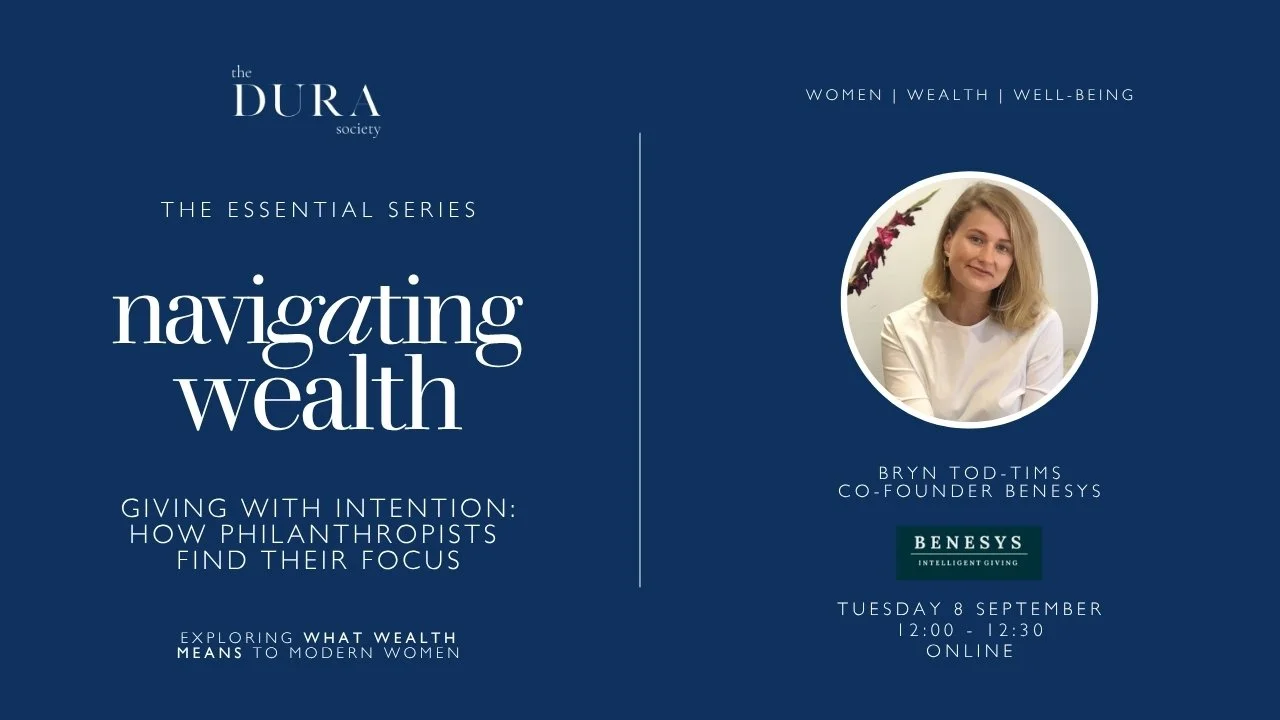
Authored with:
Bryn Tod-Tims, Co-founder | Benesys