
The Case for Investing in Your Lifespan

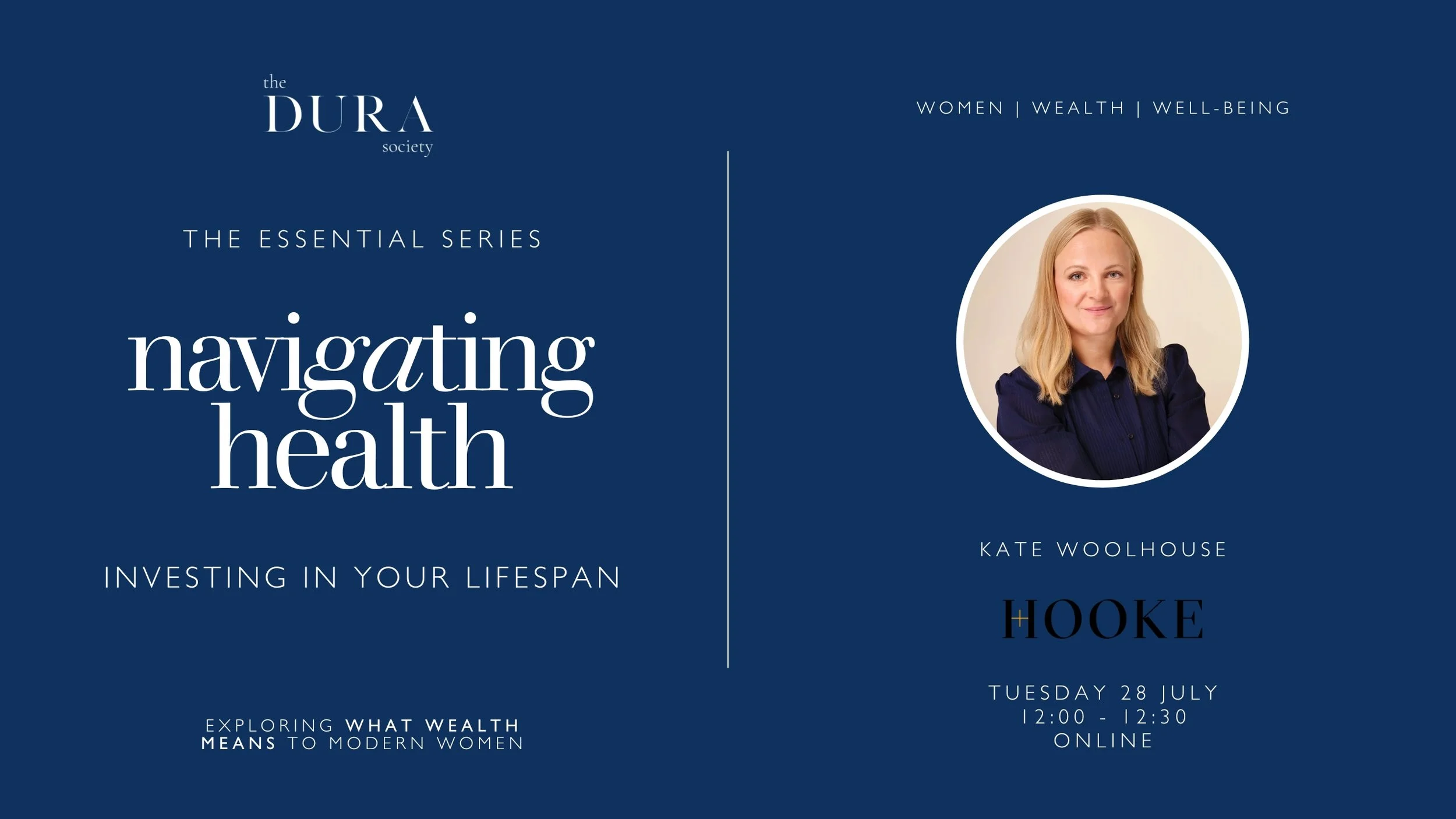
Most of us handle health problems reasonably well once they arrive. Far fewer of us think seriously about the risks quietly building for years before any symptom appears. Kate Woolhouse left a career in law to build Hooke, a Mayfair health centre working on a different model. Its team of doctors, nutritionists, fitness specialists and psychologists build a full picture of one person's risk, resilience and long term trajectory, rather than responding once something has already gone wrong. Kate joins us to discuss what it really means to invest in your lifespan, and why the most important health conversation is often the one you have not had yet.
Most of us have become fairly skilled at handling health problems once they turn up. We know how to find a good specialist, how to push for a second opinion, how to manage a diagnosis once it lands. What almost none of us do well is pay attention to the years before that, the long quiet stretch in which risk accumulates without a single symptom to announce it. By the time something shows up on a scan or in a blood test, the story has usually been writing itself for a decade or more.
This is the gap that Kate Woolhouse has spent the last seven years trying to close. She is the CEO of Hooke, a Mayfair health centre her father founded out of frustration with how little modern medicine does between appointments, and she arrived there by an unlikely route. Woolhouse spent a decade as an intellectual property and data protection lawyer, working with startups trying to build something genuinely new inside a commercial world that hadn't yet made space for them. When her father started Hooke, she recognised the shape of the problem instantly. It wasn't really a medical challenge so much as a process one: how do you take good science and deliver it as a coherent, well run service, rather than a disconnected string of appointments nobody follows up on.
Her diagnosis of the existing system is a familiar one to anyone who has spent time inside it. Healthcare, she points out, has lagged noticeably behind the standard of service that people managing significant wealth take for granted elsewhere, in private banking, in law, in travel. You can be seeing an excellent doctor at a good hospital and still find your results have gone missing, your billing is wrong, and nobody owns the relationship end to end. Layered on top of that is a more structural problem: most healthcare is reactive by design. You go when something is wrong. In between, an annual check tends to mean a basic look at bloods and a quick once over, followed by an instruction to come back if a problem develops. There is also, Woolhouse notes, a parallel world of medical spa treatments, pleasant and well presented but not always clinically grounded in what a particular person actually needs, more a nice service delivered in a nice room than a plan built around one individual's biology.
What Hooke does instead starts with a genuinely detailed onboarding. A new member has an in-depth consultation with a GP, working through medical history, family history, and personal goals, before moving into a core investigation covering medical markers, nutrition, fitness, cognitive function and emotional resilience. From there, people can layer in whatever imaging or advanced testing is relevant to them, MRI, coronary angiograms, DEXA scans, genetic testing, gut biome analysis. Woolhouse is emphatic that this isn't about throwing every available test at every person. Some tests carry their own risks, and more data isn't automatically useful data. The results are then interpreted by the full clinical team together, and delivered back to the member in a session that can run to two hours, followed by an ongoing membership built around unlimited access to that team: a relationship manager, a GP, concierge support, and whatever combination of nutrition, fitness, coaching or supplementation the picture calls for.
The team structure matters more than it might first appear. A GP is, by necessity, a generalist. A nutritionist looks at food. An endocrinologist looks at hormones. Left in isolation, each specialist tends to see a problem only through their own lens, and it's often in the space between specialities that things get missed. Woolhouse describes hormonal shifts as a good example: a psychologist might notice a mood change, a nutritionist might notice that a metabolism which used to respond predictably to certain habits suddenly isn't, and neither observation alone tells the full story. It's only when the team sits down together, rather than passing a person along a chain of referrals, that the pattern becomes visible. That, she says, is the real value of the model: not more information, but a group of people actually looking at the same picture at the same time.
Ask her what tends to surface when someone comes in for the first time, and the answers are rarely dramatic. Alongside screening for anything serious, like coronary plaque or early cancer, the more common findings are things like over supplementation with vitamins whose purpose people can't quite explain, undersupply of others, and a surprising amount of osteopenia, the early stage of low bone density, showing up far earlier than expected, in people in their thirties, and increasingly in men as well as women. It's linked to hormones, to diet, to whether someone dieted heavily when younger, and it responds well to attention: diet, supplementation, strength training. What Woolhouse describes most often, though, is a pattern among high performing people of simply normalising what's happening to them, powering through poor sleep or a nagging injury or constant fatigue until the data makes it undeniable. Most arrive convinced they're doing everything right, and the team's job is often just to point out, gently, that there's still meaningful room to improve.
On the question of how much of long term health is fixed by biology versus shaped by behaviour, Woolhouse cites research suggesting genetics accounts for somewhere under half of the picture, with more than fifty per cent modifiable through choice. Even where a genetic risk is fixed, she says, behaviour can often shift its timing or severity substantially. Alzheimer's is the clearest example she gives: someone carrying a higher risk genetic marker might still not become symptomatic until their late nineties, at which point the disease may barely have time to progress. Sleep, exercise and diet remain, in her view, the biggest levers available, more significant than almost any single test result.
Data itself, she's careful to say, isn't inherently valuable. More tests aren't automatically better, and a lot of what circulates online, cheap at home allergy and intolerance kits chief among them, produces noise rather than insight. Genuine allergy testing looks quite different from the kind of finger prick kits marketed on social media, which often flag entirely normal reactions as intolerances and then sell a restrictive diet plan to manage them. The only reliable way to identify a true intolerance, she notes, is the far less glamorous process of tracking symptoms, eliminating foods, and reintroducing them methodically. It doesn't fit neatly into a post, but it's what actually works.
For the kind of life many Dura members lead, businesses to run, frequent travel, family responsibilities stretched across time zones, Woolhouse sees a consistent set of patterns: disrupted sleep, chronic low grade stress, decision fatigue that quietly erodes food and exercise choices, and a reliance on short term fixes, supplements, caffeine, intense bursts of exercise that aren't sustained long enough to do much good. None of this shows up dramatically in a standard blood panel. It surfaces instead in recovery markers, elevated resting heart rate, low heart rate variability, a general fraying at the edges that's easy to dismiss because nothing has technically gone wrong yet. Hooke's approach is to build lifestyle context into a person's plan from the outset, working with a sleep specialist who also advises elite athletes on managing circadian disruption from travel, rather than prescribing a protocol that quietly assumes a stable life at home.
Women navigating hormonal transitions, business change and shifting family structures all at once present a particular version of this problem. Woolhouse is candid that she sees many women in this position being prescribed antidepressants when the underlying driver is a physiological and lifestyle shift rather than a purely psychological one. The symptoms, mood, metabolism, cognitive load, tend to feed into each other rather than tracing back to a single cause, and what works at thirty five won't necessarily work at forty five or fifty five. It's precisely the kind of layered, shifting picture that a single practitioner working alone is poorly placed to untangle, and where a team looking at it from several angles at once, nutrition, hormones, coaching, sometimes HRT, tends to find answers faster.
Asked how to cut through the noise around longevity right now, given the sheer volume of supplements, wearables and recovery protocols currently being marketed as essential, Woolhouse's answer is simple: you need your own baseline data before any of it makes sense. Without it, you're spending money treating a problem you may not actually have, with no real way of knowing whether it's working. Her advice for anyone wanting to start seriously investing in their own health is to begin with a proper, comprehensive blood panel, covering standard markers alongside hormones and micronutrients, ideally repeated in six to twelve months to see what's actually shifting. From there, she suggests picking no more than a couple of areas to focus on rather than trying to overhaul everything at once, and thinking in horizons of a year rather than a fortnight.
She's also a proponent of treating health reviews the way many Dura members already treat financial ones, on a quarterly rhythm, not necessarily rerunning every test each time, but checking in honestly on diet, sleep and exercise over the previous three months and setting an intention for the next. Health, she points out, is dynamic by nature, full of peaks and troughs regardless of how well managed it is. The point of the work isn't to eliminate those fluctuations but to build enough resilience that the troughs don't knock someone off course.
Some of the shifts she's seen make the biggest difference sound almost too ordinary to mention. One client, a law firm partner drinking around twenty coffees a day, was found to be running on caffeine rather than nourishment, anxious and sleeping poorly as a result; getting that down to three or four cups changed things considerably. Another client, prone to catastrophising every problem into a crisis, was taught a fifteen second exercise by a Hooke coach: asking simply whether the thing she was worried about was actually fatal, and if not, moving straight to what she'd do about it. It sounds almost too simple to matter, and yet, Woolhouse says, it changed how she moved through her days almost immediately.
Her advice for anyone bringing a concern to a first conversation with the team is to be as specific as possible. "I'm tired" tells a clinician very little. "I'm tired despite sleeping eight hours and eating well, and it started three months ago" gives them somewhere to start. The team's task from there is to look past the presenting complaint to what's actually driving it, working from the obvious explanations through to the less obvious ones until something fits.
It's a philosophy that, in the end, has less to do with biohacking or chasing an extreme extension of lifespan and more to do with a fairly practical proposition: most of us will live to eighty or ninety regardless, and the real question worth asking is how many of those years we'd like to spend well. For a community already fluent in thinking seriously about long term planning, in wealth, in succession, in the structures that protect a family for decades ahead, applying the same seriousness to health may be one of the more overdue conversations still waiting to happen.
Your LIFESPAN Checklist: 6 Essential Considerations
Get a proper baseline. A comprehensive blood panel, covering standard markers, hormones and micronutrients, is the starting point everything else builds from. Without it, you're guessing.
Repeat it. A single test tells you where you are. Repeating it in six to twelve months tells you what's actually changing, which is the more useful number.
Pick two things, not twenty. Resist the urge to overhaul everything at once. Choose the one or two areas most likely to move the needle and give them proper attention.
Treat it like a quarterly review. The same discipline applied to finances, checking in, adjusting, planning ahead, applies just as well to health. An annual check is not enough on its own.
Watch bone density earlier than you'd expect. Osteopenia shows up well before the years it's typically associated with, and it's one of the more actionable findings available.
Be specific when something feels wrong. "I'm tired" tells a clinician very little. When it started, what's changed, and what you've already tried gives them somewhere real to begin.
Build in resilience, not perfection. Health is dynamic by nature. The aim isn't to eliminate the troughs, it's to be well enough placed that they don't derail you.
Authored with:
Kate Woolhouse, CEO | Hooke